


News

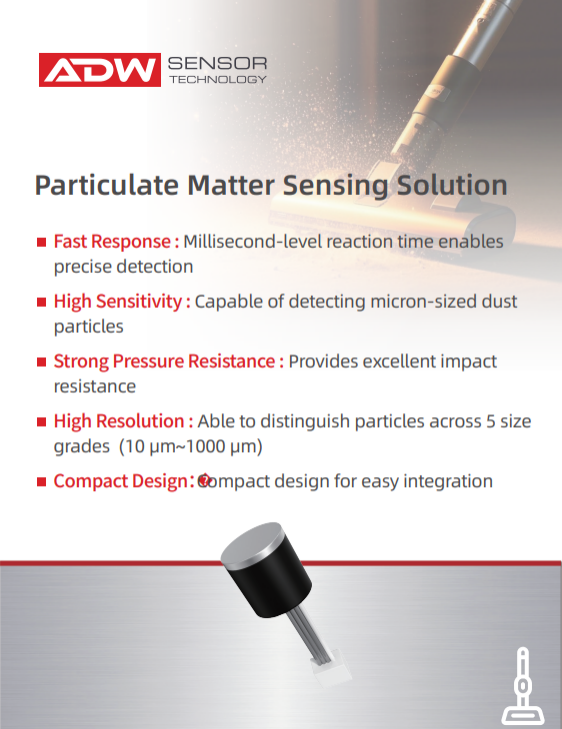
Particulate Matter Sensing Solution exhibited at the Consumer Electronics Show (CES) in Las Vegas, USA.
Consumer Electronics Show (CES)
Dates: January 6–9, 2026
Location: Las Vegas, USA
Booth Number: North Hall 10529
Traditional vacuum cleaners operate with a fixed power strategy, often wasting energy on fine dust or failing to fully remove larger debris. The Particulate Matter Sensing Solution introduces a new paradigm: real-time, in-line particle size detection that enables dynamic, intelligent cleaning.
Core Working Principle: From Impact to Insight
The process begins as the vacuum cleaner adsorbs dust particles under negative pressure. When these accelerated particles travel through the duct and impact the inner wall, they generate distinct vibration signals. These minute vibrations propagate in the form of stress waves through the duct material to a highly sensitive sensor mounted on the exterior.
The sensor acts as the system's "ear," converting these stress wave signals into electrical signals. Sophisticated embedded algorithms then analyze the signal characteristics—such as amplitude, frequency, and duration—which are uniquely correlated to the mass and kinetic energy of the impacting particle. This analysis allows the system to determine the size and concentration of the dust particles in real-time.
Enabling Intelligent Cleaning Strategies
This real-time data transforms a passive appliance into an intelligent system. By detecting particle size, the vacuum cleaner's control unit can make immediate adjustments:
For fine dust (e.g., pet dander, pollen): It may reduce suction power to save energy and prevent filter clogging, while ensuring efficient capture.
For large debris (e.g., crumbs, sand): It can instantly boost motor power and airflow to ensure complete removal on the first pass.
This enables targeted cleaning, optimizing performance for the specific contaminant profile of different floor types (carpet vs. hardwood) or cleaning events.
Key Benefits: Performance and Efficiency
This solution offers significant advantages over conventional designs:
Improved Cleaning Efficacy: Ensures optimal power is applied for all particle types.
Enhanced Energy Efficiency: Dynamically minimizes power consumption, extending battery life in cordless models.
Proactive System Health Monitoring: Can alert users to full dustbins or system blockages based on abnormal signal patterns.
Conclusion
The Particulate Matter Sensing Solution represents a significant leap forward in cleaning technology. By listening to the sound of dust itself, it provides the data needed for truly adaptive and efficient cleaning, marking a step towards fully autonomous and intelligent home appliance ecosystems.
 Come Back