


News

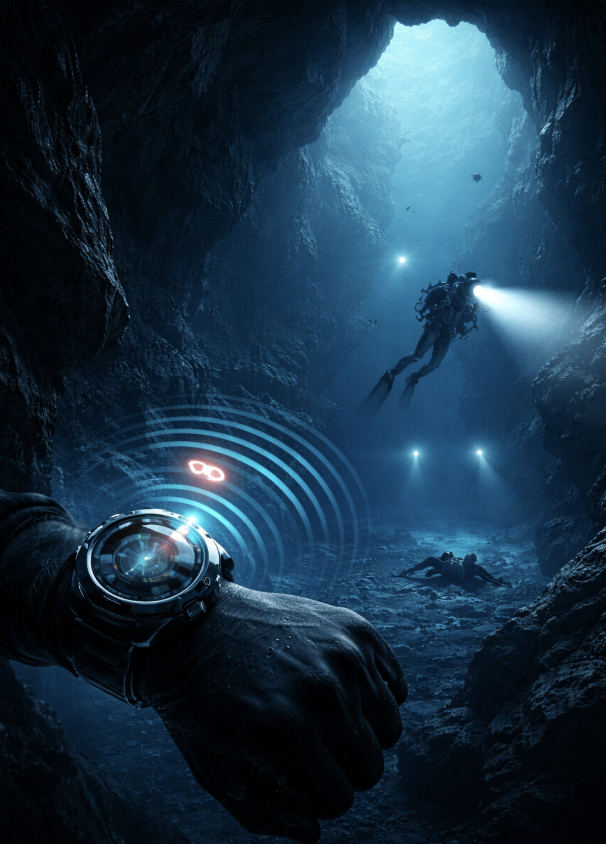
A single unexpected incident during a deep dive—more than 100 meters underwater—not only exposed the extreme risks of cave diving, but also brought a long-standing technological gap into sharp focus: the absence of reliable underwater communication. In that tragic mission, a diver failed to return as planned. The location, often referred to as the “Mount Everest of China’s underwater world,” is known for its extraordinary depth and complex environment, making rescue operations exceptionally difficult.
This incident serves as a sobering reminder to the entire industry: reliable underwater communication is a lifeline, and its absence is no longer a problem that can be ignored.
Fundamental Principles of Underwater Communication:
Why Sound Waves Are the Only Viable Option
Although oceans cover more than 71% of the Earth’s surface, their unique physical properties make them a communication blind zone. Once submerged, the electromagnetic signals we rely on daily become almost completely ineffective.
Electromagnetic waves experience near-fatal attenuation underwater—especially in seawater, which contains high concentrations of inorganic salt ions and therefore behaves as a highly conductive medium. This conductivity rapidly absorbs and dissipates electromagnetic energy. Conventional radio waves, as well as infrared lasers commonly used in optical communication, are fundamentally constrained by this physical reality.
Studies show that a 1 MHz electromagnetic wave can experience attenuation of up to 300 dB per meter in water. After traveling just one meter, the signal strength is reduced to one-thousandth of its original value, rendering it completely unusable for communication.
As a result, neither mobile phone signals nor satellite communications can effectively penetrate underwater—this is a fundamental limitation dictated by the physics of electromagnetic waves themselves.
In contrast, acoustic waves, as mechanical waves, emerge as the clear winner for underwater communication. Sound propagates through molecular vibration of the medium, and its attenuation coefficient in water is three to five orders of magnitude lower than that of electromagnetic waves.
Low-frequency sound waves around 1 kHz can travel tens of kilometers underwater. Even ultrasonic waves at 150 kHz experience far less attenuation than electromagnetic waves. For this reason, acoustics remain the only practical solutionfor underwater communication today—although it should be noted that attenuation still increases rapidly with distance at higher frequencies.
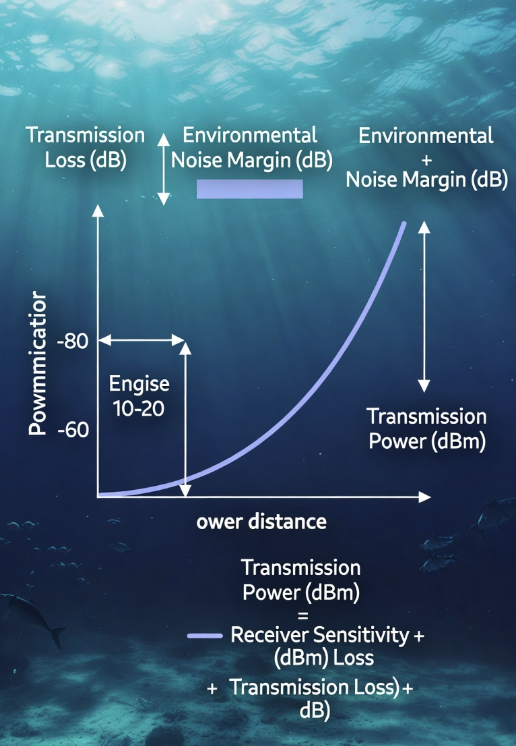
Underwater acoustic communication strictly follows a power–distance relationship: the required transmission power and system architecture are directly determined by communication range. This relationship can be expressed as:
Transmit Power (dBm) = Receiver Sensitivity (dBm) + Transmission Loss (dB) + Environmental Noise Margin (dB)
For consumer-grade acoustic receivers, typical sensitivity is around –80 dBm (0.1 nW). Environmental noise usually requires an additional 10–20 dB margin. Among these variables, transmission loss is the most critical, as it increases exponentially with distance.
The Gap Between Theory and Reality
Different communication distances lead to drastically different power requirements:
Short range (1–5 m)
For example, data exchange between smartwatches requires approximately 10–50 mW, which remains within acceptable limits for wearable devices.
Medium range (5–50 m)
Required power rises sharply to 1 W or more, far exceeding the power budget of typical consumer electronics.
Professional range (kilometers)
Taking professional systems such as the S2CR series as an example, achieving a range of 3,500 m requires up to 65 W of transmission power.
In practice, theoretical calculations often severely underestimate actual requirements—sometimes by a factor of 1,000. This gap is primarily caused by two factors:
Electro-acoustic conversion losses, with approximately 22% of energy lost during sound–electric conversion.
Dynamic environmental factors, such as water quality, currents, and temperature gradients, which can increase real-world attenuation by an additional 20–50% over theoretical values.
These realities define a clear ceiling for smartwatch-based underwater communication:
Power Consumption Constraints
To maintain acceptable battery life, average communication power must remain in the milliwatt range.
Hardware Limitations
The maximum output power of miniature piezoelectric ceramic transducers inside a smartwatch is typically only 10–50 mW.
Thermal Bottlenecks
In the confined space of a wearable device, watt-level transmission power generates heat that cannot be dissipated safely, posing risks of overheating and device failure.
As a result, with current technology, reliable underwater communication for smartwatches is effectively limited to within 10 meters.
Paths Toward Technological Breakthrough
Despite these strict physical constraints, the industry is making progress through multi-layered optimization, transforming the concept of “watch-based rescue signaling” into a practical and valuable solution.
In rescue scenarios, real-time voice communication is not essential. Instead, transmitting a minimal critical data packet—for example, 56 bytes containing location, status, and an SOS identifier—is sufficient.
By adopting a burst transmission mode (single transmission ≤ 1 second), average power consumption can be kept below 10 mW, aligning with smartwatch battery constraints.
Frequency Selection
Using low-frequency sound waves in the 18–34 kHz range reduces attenuation by approximately 40% compared to commonly used 150 kHz ultrasonic frequencies.
Energy Focusing
Integrating digital beamforming technology concentrates acoustic energy in a specific direction, providing an effective gain of 5–10 dB.
The direct communication range of a single smartwatch is defined as 5–8 m. Once an SOS signal is transmitted, nearby divers wearing compatible devices automatically act as relay nodes, forwarding the signal.
With just three relay hops, the effective rescue radius can be extended to 20–25 m, sufficient to cover most recreational and technical diving scenarios.
The device remains in sleep mode for 99% of the time, consuming ≤ 0.1 mW, and wakes periodically for environmental monitoring. After SOS activation, a pulsed transmission strategy is used (one transmission per second, 0.1 s duration each), keeping average power consumption ≤ 5 mW.
Advanced stacked piezoelectric ceramic structures further improve acoustic energy conversion efficiency to over 85%within an ultra-compact form factor.
The fundamental path to next-generation breakthroughs lies in materials innovation. New generations of piezoelectric transducers could potentially increase output power by 3–5× within the same volume, laying a physical foundation for more capable consumer devices.
Algorithmic optimization is equally critical. By leveraging AI algorithms to dynamically adapt frequency and power based on water conditions and distance, systems can continuously match optimal communication parameters and maximize the efficiency of limited power budgets.
The industry has already taken tangible steps. For example, the Huawei WATCH Ultimate 2, equipped with its “Dolphin Communication” system, uses miniature sonar technology to enable smartwatch-to-smartwatch messaging within 30 meters, including built-in SOS functionality. This marks a significant milestone: consumer devices have officially entered the field of underwater communication.
Every deep dive carries unknown risks. Establishing a reliable underwater communication lifeline is one of the most critical safeguards that technology can offer explorers. As one industry veteran aptly stated:
“We must prepare the best technology for the worst-case scenario.”
Today, innovation is clearly converging on this goal—enabling smart devices to protect lives even in extreme environments. This is not merely a technological breakthrough, but a meaningful response to humanity’s enduring spirit of exploration.
 Come Back