


News

Engineered with advanced acoustic impedance matching and robust chemical isolation to deliver superior signal-to-noise ratio in low-flow and corrosive custody transfer environments.

1. Industry Dynamics & Regulatory Drivers
Designing next-generation gas meters is no longer just about meeting OIML R137 or MID compliance—it’s a battle against zero-flow drift, signal blackout, and catastrophic field failures. As global networks transition to smart metering and aggressive hydrogen blends, traditional acoustic flow sensors are pushed far beyond their physical limits. Unpredictable signal attenuation in low-pressure lines, severe turbulent acoustic noise, and chemical degradation from trace contaminants often transform a promising prototype into an expensive field recall. For system architects, overcoming sub-optimal acoustic coupling is no longer a minor tuning step; it is the ultimate bottleneck to safeguarding long-term measurement stability and total cost of ownership (TCO)。
2. Technology Architecture: Solving the Acoustic Gap
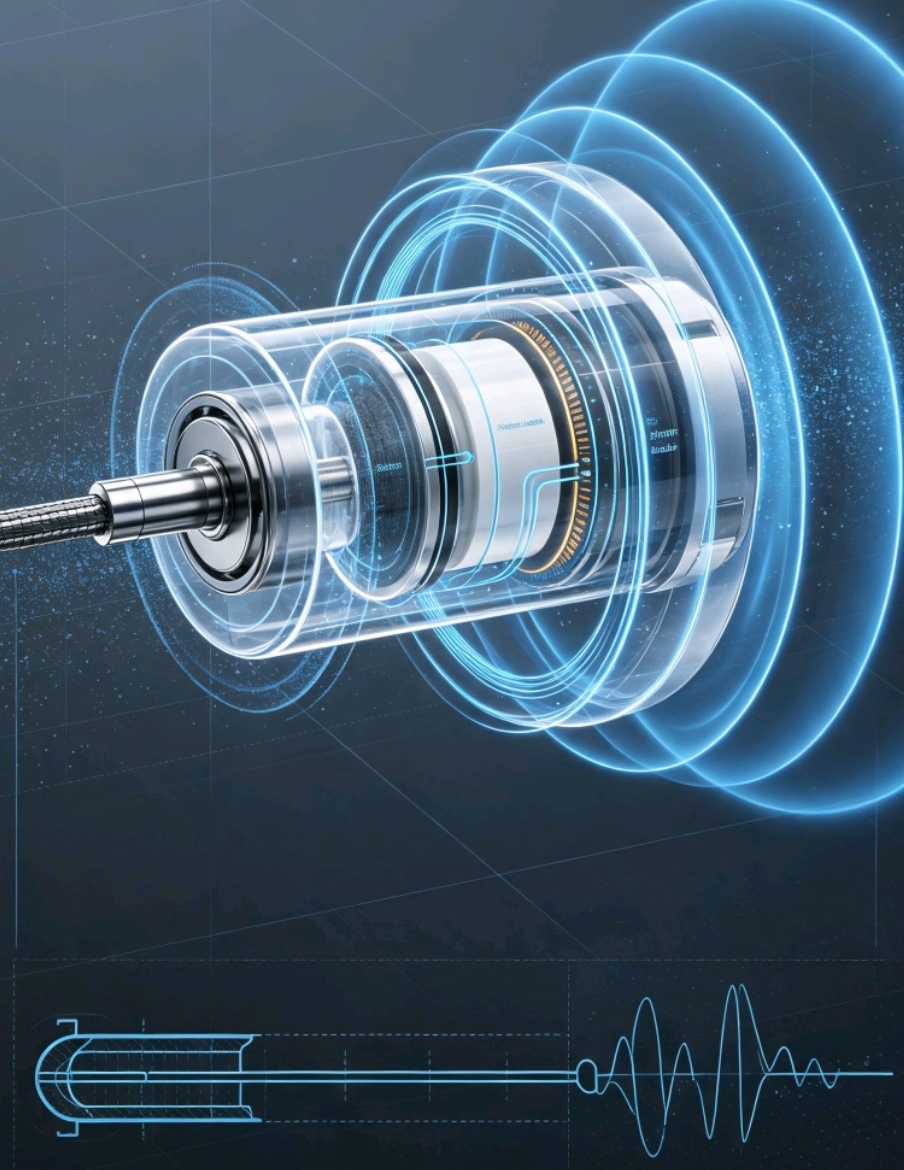
The ADW GS Series addresses these critical failure modes by optimizing the electro-acoustic transition path.
Acoustic Impedance Matching: Featuring a proprietary formulation matching layer, the GS Series achieves optimal acoustic coupling between the high-density piezoelectric element and low-density gas media. This results in an exceptionally high receiving sensitivity of ≥90 mV (under 215 kHz / 3.3 Vp-p drive condition) for the GS0001-000 model. This superior signal-to-noise ratio allows metering algorithms to resolve nanosecond-level propagation time-of-flight (ToF) differences, extending the meter’s lower detection limit into micro-flows.
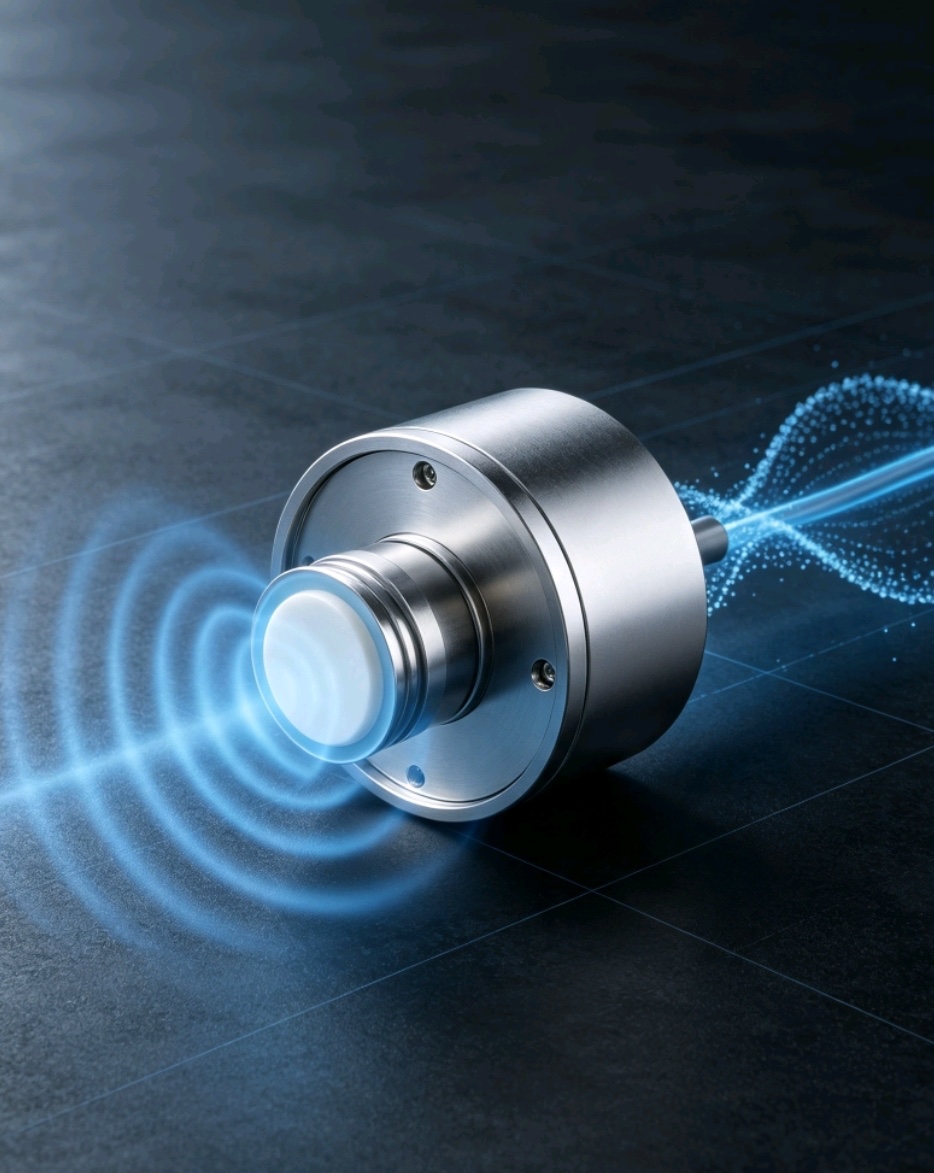
Dual-Frequency Strategy for Variable Pipe Geometries: To accommodate diverse pipe diameters and flow velocity profiles, the GS Series is offered in 215 kHz (GS0001-000) and 530 kHz (GS0002-000) variants. The 215 kHz model features a 12∘±2∘ directivity angle, optimized for standard reflective flow channels with longer acoustic paths (recommended 6 to 12 cm). The 530 kHzmodel utilizes a narrower 6∘±2∘ beam angle, concentrating acoustic energy to minimize pipe-wall multipath interference in compact residential meters.

3. Case Study: Mitigating Zero-Flow Drift in Utility Smart Meters
Optimal Path Geometry: For small-bore residential gas meters, a V-shaped reflective installation configuration is highly recommended. By utilizing the internal pipe wall to reflect the acoustic wave once, this setup effectively doubles the acoustic path length 6 to 12 cm with minimal signal attenuation, providing stable differential time calculations (time up – time down) even during high velocity fluctuations.
Environmental & Chemical Protection: The GS Series features a specialized corrosion-resistant enclosure and an isolated internal housing. To maximize operational lifecycle (10+years), design engineers should ensure sealing materials (e.g., O-rings) align with local gas composition specifications. The transducer maintains calibration consistency across an operating temperature range of -25°C to +55°C and pressures up to 0.2 MPa.
4. Engineering & Reliability
Corrosion Isolation & Durability: Engineered with a specialized corrosion-resistant enclosure and an isolated internal housing structure, the GS Series ensures the active piezoelectric ceramics remain completely shielded from aggressive trace elements in coal gas and natural gas pipelines. With an operating temperature range of −25°C to +55°C and a maximum pressure rating of 0.2 MPa, the transducer guarantees continuous calibration consistency over a 10+ year operating lifecycle.
Integration and Path Design: For optimal measurement resolution in small-bore residential gas meters, a V-shaped reflective installation configuration is highly recommended. By utilizing the internal pipe wall to reflect the acoustic wave once, this setup effectively doubles the acoustic path length (L) with minimal signal attenuation, providing stable differential time calculations (time up−time down) even during high velocity fluctuations.
5. Selection Matrix & Engineering Specifications
The following reference matrix outlines the core performance parameters of the GS Series designed to assist R&D engineers during the early-stage hardware selection process:
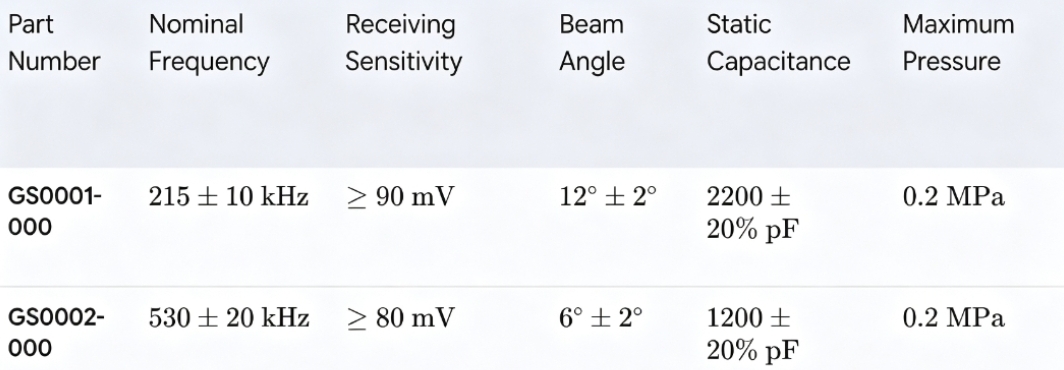
All specifications are verified under standard laboratory conditions (25°C±3°C, Relative Humidity 45%−75%) unless otherwise specified.
6. Accelerate Your Prototyping Phase
ADW supports global utility meter manufacturers from initial acoustic design through to mass production. Our engineering team provides physical flow channel modeling (FEA simulation), impedance matching analysis, and rapid-prototyping support.
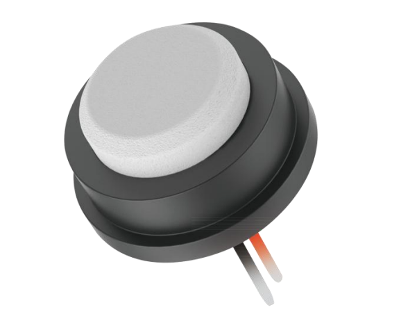
Request Evaluation Samples: To secure matched pairs of the GS0001-000 or GS0002-000 for laboratory verification, please submit your application request to our team at info@adwsensor.com.
 Come Back