

News

From precise ranging to wireless data transmission, enabling more reliable underwater sensing and connectivity
As robotic pool cleaners, autonomous underwater vehicles, and intelligent marine equipment continue to evolve, reliable sensing and communication are becoming essential. However, low visibility, suspended particles, and electromagnetic signal attenuation present significant challenges for conventional technologies.
Ultrasonic technology offers an effective alternative by using acoustic waves to measure distances and transmit information underwater. ADW's underwater ultrasonic ranging and communication solutions are designed to support obstacle detection, environmental awareness, and wireless data exchange across a range of underwater applications.
1. Why Underwater Environments Require Different Sensing Technologies
Cameras and optical sensors provide valuable visual information, but their performance depends on lighting conditions and water clarity. In dark or turbid water, light absorption and scattering can significantly reduce visibility and detection range.
Millimeter-wave (mmWave) radar performs well in air, but high-frequency electromagnetic wavs experience substantial attenuation in water, particularly in conductive seawater. This limits their effectiveness for conventional underwater ranging applications. Ultrasonic sensing operates differently. As a mechanical wave, sound propagates through water without relying on ambient light. With appropriate frequency selection and system design, acoustic technology can provide practical underwater ranging and wireless communication capabilities.
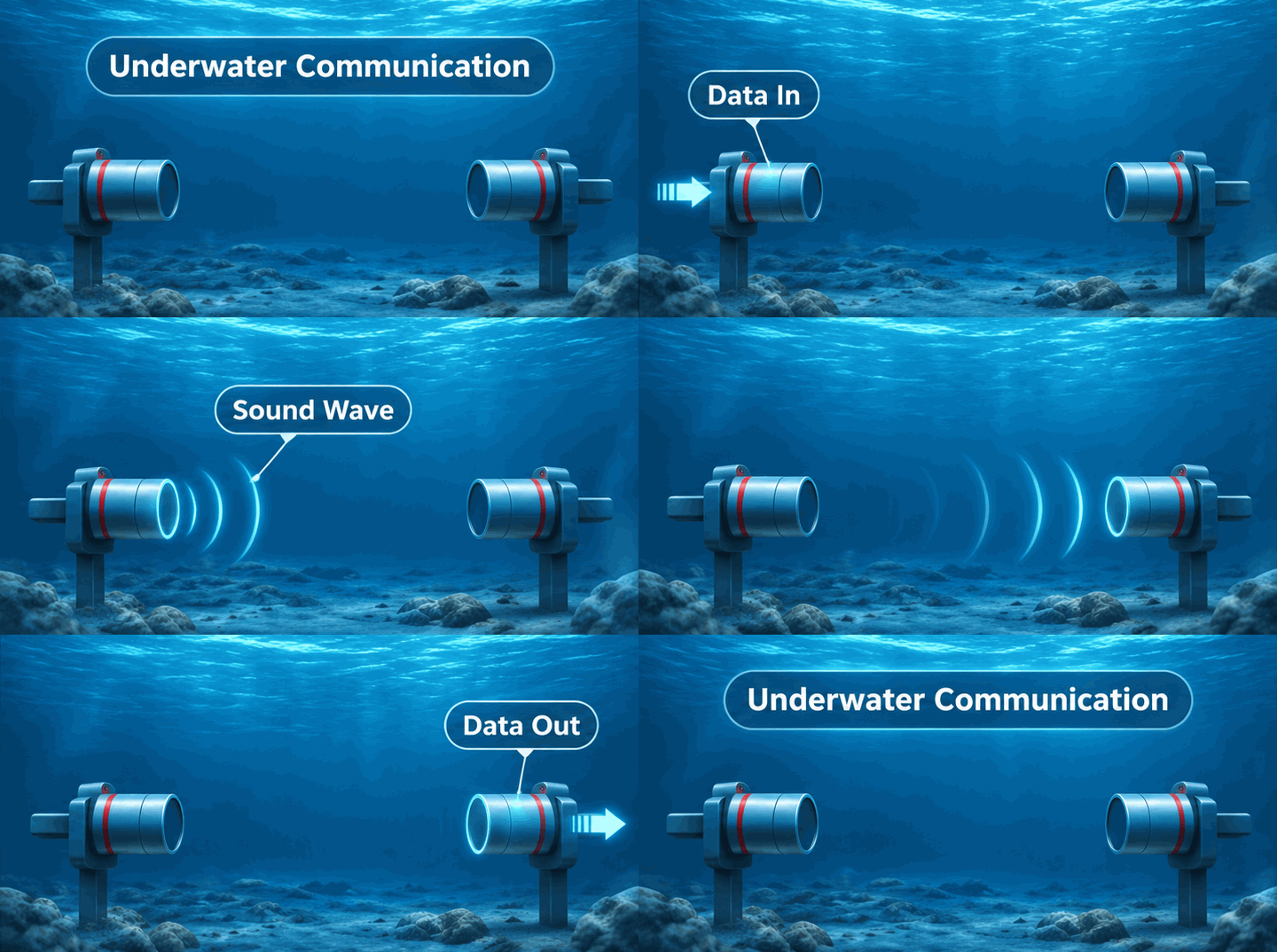
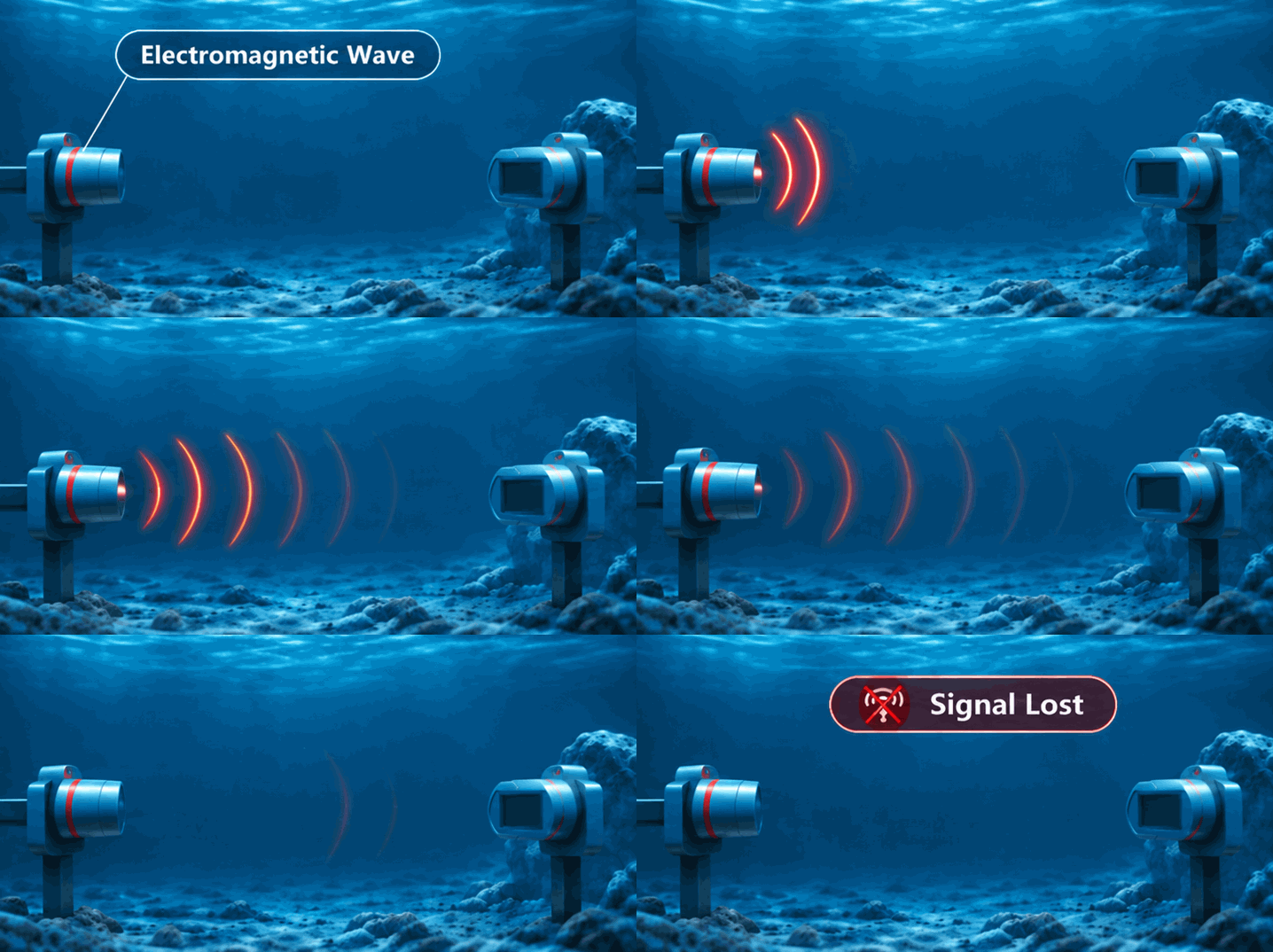
| Figure 1. Ultrasonic waves enable underwater acoustic communication. | Figure 2. High-frequency radio signals attenuate rapidly in seawater. |
Underwater ultrasonic ranging sensors operate on the Time-of-Flight (ToF) principle.
The sensor emits an ultrasonic pulse into the water. When the pulse encounters an object, part of the acoustic energy is reflected toward the receiver. By measuring the round-trip travel time and accounting for the speed of sound in water, the system calculates the distance to the target. Unlike optical sensing, ultrasonic ranging does not require visible light, making it particularly useful for obstacle detection, distance monitoring, and short-range navigation assistance in dark or low-visibility environments.
According to ADW's product information, its underwater ranging technology offers measurement capabilities of up to 10 meters, with accuracy reaching 10 mm in specified configurations. The solution also features IP68 protection. Actual performance depends on the selected model, installation conditions, target characteristics, and operating environment.
Beyond distance measurement, ultrasonic technology also enables underwater wireless data transmission.
An underwater acoustic communication system converts modulated electrical signals into acoustic waves through a transducer. At the receiving end, the acoustic signals are converted back into electrical signals, demodulated, and decoded to recover the transmitted information. Compared with conventional high-frequency radio communication, which experiences substantial attenuation underwater, acoustic communication can provide more practical transmission distances under suitable conditions.
It also reduces reliance on physical communication cables, allowing greater flexibility for mobile underwater equipment.
ADW's underwater acoustic communication solution supports bidirectional data exchange and incorporates features such as UART connectivity, integrated communication and ranging functions, and in-system programming (ISP) for firmware updates. These capabilities support control command transmission, equipment status reporting, and information exchange between underwater devices.
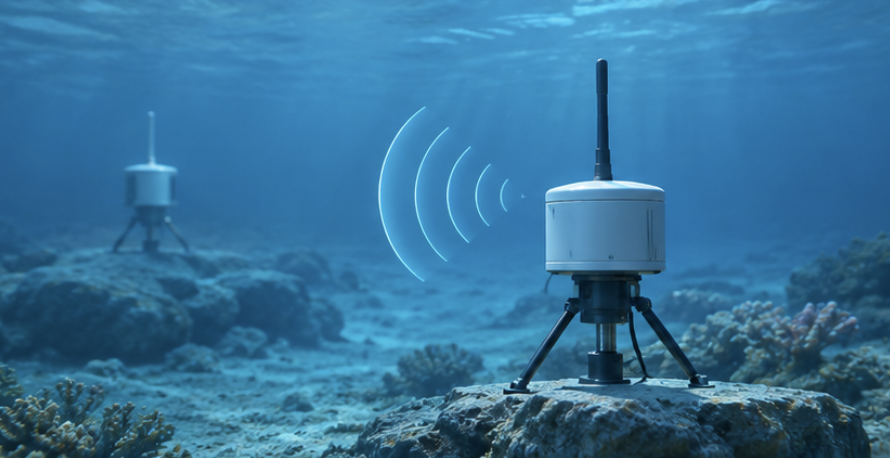
Robotic Pool Cleaners
Ultrasonic ranging sensors help robotic pool cleaners detect pool walls and nearby obstacles, supporting navigation and collision avoidance. Combined with underwater acoustic communication, robots can exchange control information and operating status with underwater communication nodes, supporting intelligent cleaning and coordinated operation.
Underwater Robots (ROVs and AUVs)
For remotely operated vehicles (ROVs) and autonomous underwater vehicles (AUVs), ultrasonic ranging provides local obstacle-distance information to assist with navigation and close-range operations.
Acoustic communication can complement existing communication systems by transmitting status updates, control information, and coordination data during underwater missions.
Underwater Monitoring and Intelligent Equipment
In underwater infrastructure monitoring, equipment status collection, and other connected applications, ultrasonic technology can support distance detection and low-data-rate wireless communication, reducing dependence on optical sensing or wired connections in selected applications.
The advancement of intelligent underwater equipment requires both accurate environmental awareness and reliable connectivity.
Ultrasonic ranging and acoustic communication provide complementary capabilities. Ranging helps devices understand the distance to surrounding objects, while communication enables information exchange between underwater systems.
By integrating these technologies, equipment manufacturers can develop more capable underwater devices for autonomous operation and coordinated tasks.
ADW continues to explore ultrasonic sensing and communication technologies, providing flexible acoustic solutions for robotic pool cleaning, underwater robotics, and emerging intelligent underwater applications.
Exploring an Underwater Ultrasonic Sensing or Communication Solution for Your Project?
Contact us at info@adwsensor.com and share your company and contact details, target application, operating environment (such as water depth and water conditions), required sensing range or communication distance, accuracy or data transmission requirements, available installation space, and project stage.
Technical drawings, product specifications, or preliminary test data are also welcome to help our team evaluate a suitable solution for your application.
 Come Back