


News

ADW’s independently developed ultrasonic scalpel transducer has attracted significant attention from ultrasonic surgical system manufacturers, R&D engineers, and industry professionals due to its outstanding performance and highly reliable technical design. With its advanced piezoelectric technology and stable operational characteristics, the product has become a key component solution for next-generation ultrasonic surgical systems.
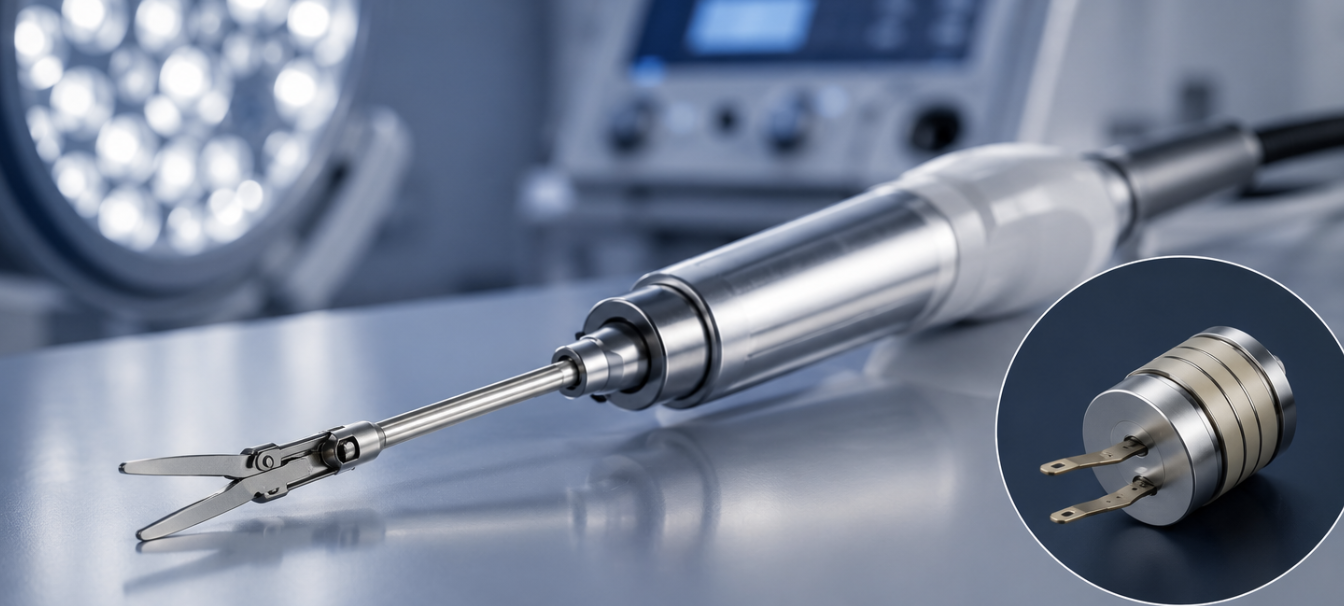
At the core of every ultrasonic surgical device is the transducer, responsible for converting electrical energy into high-frequency mechanical vibration. This vibration drives the surgical blade to achieve simultaneous tissue cutting and coagulation with exceptional precision.
The ADW ultrasonic scalpel transducer operates based on the inverse piezoelectric effect of piezoelectric ceramics. When alternating voltage is applied to the piezoelectric elements, internal polarization occurs within the material, producing rapid longitudinal deformation. This process enables highly efficient and precise conversion of electrical energy into stable ultrasonic mechanical vibration.
Compared with conventional transducer solutions, ADW’s proprietary design achieves major improvements across several critical performance indicators:
Stable frequency performance ensures that the ultrasonic blade continuously operates at its optimal resonance point during surgical procedures, minimizing efficiency loss and reducing the risk of thermal tissue damage caused by frequency drift.
The high D33 coefficient enables larger amplitude displacement, delivering cleaner and faster cutting performance. Meanwhile, the elevated Qm value significantly reduces internal heat generation, providing a robust hardware foundation for precise cutting, low thermal impact, and rapid coagulation.
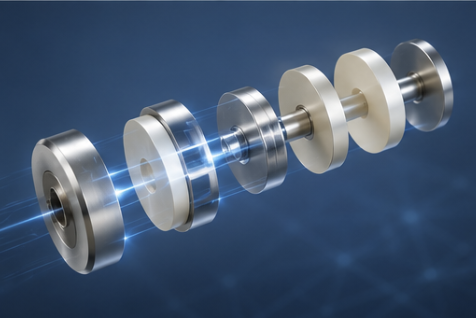
The transducer delivers highly pure ultrasonic output with minimal frequency drift, reducing the need for complex compensation circuits and improving overall system reliability.
Thanks to its optimized D33 performance, the transducer achieves strong mechanical displacement, enabling rapid and effective cutting of soft tissue and blood vessels.
The high Qm characteristic allows electrical energy to be converted into mechanical energy with exceptional efficiency, minimizing temperature rise and ensuring operational safety during long surgical procedures.
Advanced material formulations and optimized structural design maintain stable performance under repeated high-intensity operation, significantly extending product lifespan and reducing replacement frequency.
Together, these advantages directly address key clinical demands: achieving fast cutting speeds while minimizing lateral thermal damage, enabling a “cold cutting” effect that supports improved postoperative recovery.
As a pioneer in piezoelectric ceramics and sensing technologies, ADW remains committed to innovation driven by core materials and fundamental process technologies.
The successful development of the ultrasonic scalpel transducer not only provides a high-performance and reliable alternative solution for advanced ultrasonic surgical systems, but also enables medical device manufacturers to benefit from stable supply capability, rapid technical support, and excellent product consistency.
With the increasing adoption of ultrasonic surgical systems across general surgery, urology, gynecology, and thoracic surgery, industry requirements for core transducer components continue to rise. ADW demonstrates strong expertise and innovation capability in high-end medical components through its deep accumulation in piezoelectric energy conversion technology.
Looking ahead, ADW will continue advancing piezoelectric energy conversion technologies and collaborate closely with global medical device manufacturers to support the next generation of precision surgical systems worldwide.
 Come Back